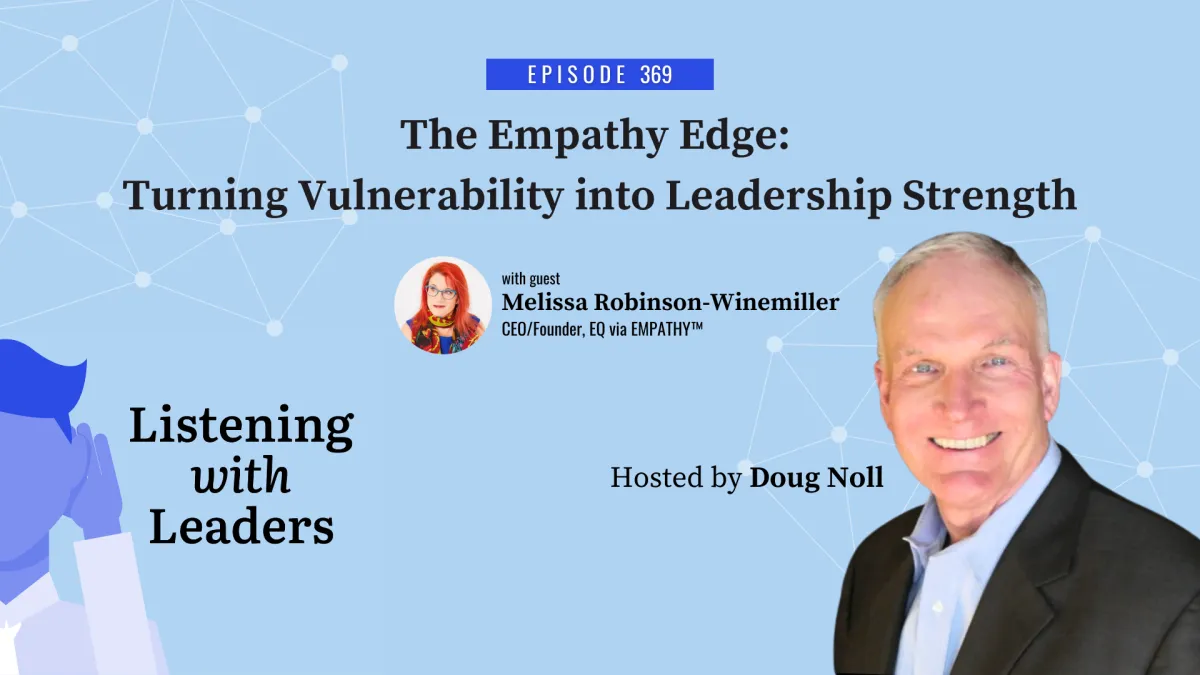
369 - The Empathy Edge: Turning Vulnerability into Leadership Strength
The Strategic Advantage of Empathy: Building High-Performance Teams Through De-escalation
In this episode of Scaling Smarter: Listening with Leaders Podcast, host Doug Noll sits down with Dr. Melissa Robinson-Winemiller, CEO and Founder of EQviaEmpathy, to dismantle the pervasive myth that emotional intelligence in leadership is a sign of operational weakness. Drawing from her background as a professional French horn player turned academic researcher and empathy consultant, Dr. Robinson-Winemiller offers a rigorous, science-backed exploration of how cognitive and affective empathy drive bottom-line execution. This conversation provides an essential roadmap for executives and business leaders looking to eliminate team friction, build psychological safety, and transform emotional awareness into a core competitive advantage.
Transforming Emotional Intelligence into Measurable Executive Performance
Many C-suite leaders hesitate to embrace empathy because they confuse emotional understanding with coddling or a lack of accountability. In reality, true empathy is a strategic tool that requires executive courage, precise boundaries, and high cognitive awareness. By distinguishing between cognitive empathy—intellectually grasping another's perspective—and affective empathy—experiencing their emotional state—leaders can navigate high-stakes negotiations and internal conflicts without losing command over business objectives. When executives learn to accurately identify and label the emotions of their workforce, they quiet the brain's threat centers, rapidly de-escalating interpersonal friction and restoring clear, rational problem-solving across departments.
Building an empathetic corporate culture directly impacts an organization's psychological safety, which is the single greatest predictor of team innovation and error reduction. When executives create an environment where team members can voice concerns, admit missteps, or challenge assumptions without fear of retaliation, systemic bottlenecks are surfaced and solved before they become costly crises. As automation and artificial intelligence handle increasingly complex technical workflows, uniquely human capabilities like emotional regulation, deep listening, and situational awareness become the primary differentiators between stagnant organizations and high-growth industry leaders.
Implementing this approach across generational and cultural divides requires a nuanced, data-driven approach that tailors communication without sacrificing core accountability. Leaders must leverage neuroscience and behavioral research to demonstrate to skeptical stakeholders that emotional regulation drives retention, engagement, and operational velocity. By combining transparent operational standards with active, de-escalating communication, founders and CEOs establish an executive footprint that earns deep authority, retains elite talent, and navigates market volatility with steady resilience.
About Dr. Melissa Robinson-Winemiller
Dr. Melissa Robinson-Winemiller is an author, international speaker, trainer, and the CEO/Founder of EQviaEmpathy. Having transitioned from a high-profile career as a professional musician to an esteemed researcher and consultant in emotional intelligence, she specializes in helping organizations integrate empathy into their leadership frameworks. Her work focuses on equipping executives with actionable strategies to enhance workplace culture, reduce conflict, and drive sustainable organizational success.
About EQviaEmpathy
EQviaEmpathy is a specialized leadership consulting and training firm dedicated to elevating workplace performance through emotional intelligence and empathy frameworks. The organization provides tailored executive coaching, corporate workshops, and research-backed assessments designed to bridge communication gaps and resolve organizational conflict. By converting abstract empathy concepts into concrete behavioral skills, EQviaEmpathy helps business leaders build resilient, psychologically safe, and high-performing workplace cultures.
Links Mentioned in This Episode
Key Episode Highlights
Cognitive vs. Affective Empathy: The strategic difference between intellectually understanding a team member's perspective and experiencing their emotional state.
Debunking the Soft-Skill Myth: How leveraging neuroscience proves that emotional regulation and clear boundaries enhance executive authority rather than diminish it.
Fostering Psychological Safety: Utilizing active listening and affect labeling to encourage open dialogue, uncover systemic risks, and accelerate innovation.
Empathy as an AI-Era Differentiator: Why human emotional intelligence, critical thinking, and de-escalation are becoming the ultimate leadership assets in tech-driven markets.
Cross-Generational Leadership Adaptability: Tailoring empathetic communication strategies to align diverse workforces around shared operational targets.
Conclusion
The discussion with Dr. Melissa Robinson-Winemiller highlights that empathy, when executed with clarity and discipline, is one of the most powerful performance drivers available to modern executives. By mastering affect labeling, establishing psychological safety, and setting transparent boundaries, leaders can eliminate internal conflict and unlock their team's full operational potential. Embracing these emotional intelligence frameworks allows business leaders to navigate uncertainty, scale smarter, and build resilient organizations designed for long-term dominance.
Are you ready to explore how emotional intelligence and active listening can transform your executive leadership? I invite you to explore DougNoll.com to discover specialized conflict resolution and leadership coaching methodologies designed to optimize corporate communication.
Are you a visionary founder or executive who has leveraged emotional intelligence to transform your corporate culture? We would love to feature your story on our stage. Apply to be a guest on the Scaling Smarter: Listening with Leaders Podcast here.


