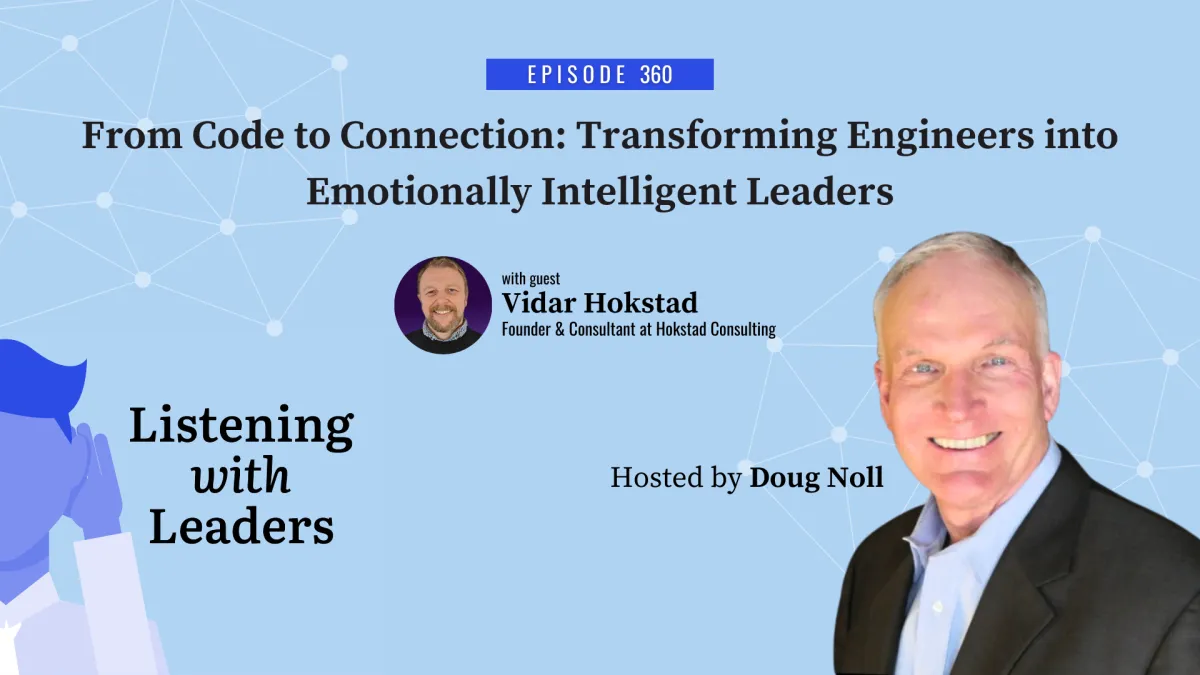
360 - From Code to Connection: Transforming Engineers into Emotionally Intelligent Leaders
Bridging the Gap: Emotional Intelligence in Technical Leadership
In this episode of Scaling Smarter: Listening with Leaders Podcast, host Doug Noll speaks with Vidar Hokstad, Founder and Consultant at Hokstad Consulting, about the often-overlooked human element in technology leadership. Vidar shares his journey from a childhood fascination with computers to leading high-stakes engineering teams through the volatility of venture capital and market shifts. The conversation moves beyond code and architecture to address the critical need for emotional intelligence (EI) in technical spaces. By reframing human emotions as a complex data set, Vidar offers a unique perspective on how "math-minded" professionals can master leadership, resolve team friction, and successfully integrate unpredictable tools like AI into deterministic systems.
Reframing Human Connection for the Technical Mind
The traditional divide between engineering teams and their non-technical counterparts—such as sales, marketing, and management—often stems from a fundamental misunderstanding of communication styles. Vidar Hokstad explains that many technical professionals view emotions as messy, irrelevant distractions that cloud logical decision-making. However, true leadership requires a mental shift to see these emotional cues as actionable information. By treating human behavior as an optimization problem or a system to be "debugged," engineers can learn to read nonverbal signals and stakeholder motivations. This approach doesn't just reduce "Us vs. Them" friction; it creates a more resilient organizational structure where technical goals align with business realities.
Transitioning from an individual contributor to a leadership role requires a deliberate investment in social skills that may not come naturally to introverted technologists. Vidar advocates for technical leaders to pursue formal training in communication and social dynamics, similar to how they would approach learning a new programming language. Understanding that people, much like the burgeoning world of AI, do not always behave in a deterministic manner is the first step toward effective management. When a leader accepts this uncertainty, they can build better feedback loops, foster psychological safety, and guide their teams through the high-pressure environment of venture-backed startups.
For many high-level technologists, the path to fulfillment doesn't always end in permanent executive management. Vidar discusses the strategic value of the fractional CTO or consultant role, which allows experts to provide massive value during phases of rapid innovation without becoming bogged down in operational routine. This flexibility allows leaders to stay hands-on with the technology they love while leveraging their developed emotional intelligence to bridge the gap between technical vision and business execution. Ultimately, balancing technical excellence with a nuanced understanding of human behavior is what distinguishes a mere manager from a visionary leader.
About Vidar Hokstad
Vidar Hokstad is a Founder and Consultant with a career spanning over two decades in cloud computing, AI, and fractional technology leadership. A self-described "deep tech" expert, he has navigated the highs and lows of the dot-com era, venture-backed startups, and massive scaling projects. Beyond the server room, Vidar is an avid writer of science fiction, a pursuit that fuels his creative problem-solving and deepens his appreciation for the complexities of human and artificial intelligence.
About Hokstad Consulting
Hokstad Consulting provides high-level technical strategy and fractional CTO services to startups and venture-backed companies. The firm specializes in helping organizations navigate complex technical hurdles, from cloud architecture to the strategic implementation of AI. By focusing on both technical mastery and organizational alignment, Hokstad Consulting ensures that technology serves as a primary driver for business growth and stability.
Links Mentioned in This Episode
Key Episode Highlights
EI as a Learnable Skill: Emotional intelligence is not an innate trait but a skill set that can be systematically refined through study and social experimentation.
The "Data" of Emotions: Engineers can bridge communication gaps by treating social cues as informative data points rather than obstacles to logic.
Timing over Technology: Groundbreaking products often fail not due to poor code, but because of market unreadiness or poor user experience; strategic patience is a leadership requirement.
Navigating Venture Pressures: Raising capital introduces risks to creative control; leaders must maintain a firm grip on their core vision while managing investor expectations.
AI as a Collaborator: Moving into the age of AI requires leaders to manage non-deterministic outcomes by breaking tasks into smaller chunks and building robust feedback loops.
Conclusion
The conversation with Vidar Hokstad highlights that the most powerful tool in a technologist's arsenal isn't a new framework or language, but the ability to understand and lead the people behind the machine. By embracing failures as learning accelerators and investing in the "soft" skills of leadership, technical founders can build teams that are as emotionally intelligent as they are technically proficient.
Explore Doug Noll’s website to learn more about leadership insights and resources: https://www.dougnoll.com/
Apply to be a guest on the Listening with Leaders Podcast here: https://podcast.dougnoll.com/podcast-guest


